
Millions more people are now claiming welfare benefits, and it’s probably fair to say that many believed it would never happen to them. So this is probably a good time to start a narrative around whether welfare benefits help or hinder employability.
Like me you’ve probably found it’s not unusual for the two issues of welfare benefits and unemployment to be couched as cause and effect; the implication that benefits ‘prop up’ people’s lives and diminish their motivation to find work. I honestly think this association has now become a lazy stereotype and we need to work together to dispel the myth. Why? Because while it’s out there, perception or otherwise, it carries a lot of weight, and that impacts heavily, not only on the by-standers who have a third party perspective, but also on those who are the main actors of the myth – the people who have been impacted through their self-esteem, and with a belief, perhaps, that they’ll never be taken seriously enough to get a job, because they’re on benefits.
It would be naïve to evade the reality that some people who are capable of working are satisfied not to, and that surviving on welfare benefits might be an option they have chosen (or that has chosen them). It’s also a truth that even in those minority of cases if we dig beyond the surface we can probably also find multiple reasons not to cast blame. But regardless, there’s no doubt we can do a lot better, recognising this connection between welfare benefits and employability as an over-simplification of what is surely one of the most complex and serious challenges for society, and one that’s been getting in the way of social justice for decades.
Unemployment of course is a complicated and multi-dimensional subject – for the unemployed themselves and for the support system at both a micro and a macro level. An important element of this support system is geared to managing welfare benefits claims but this has proven not always to be effective. Despite assumptions to the contrary, benefits are frequently under-claimed (in the millions) because the system is dogged with misinterpretation and/or misunderstanding.
For some people, benefits can hinder the prospect of employability (we explore this below, and the lazy stereotype doesn’t feature …) but more often than not this is a symptom of circumstance rather than an actual desire to be on benefits instead of earning a living. In fact there are many examples of welfare benefits making a positive contribution towards employability.
Welfare benefits actually help people to be employed
To properly consider how benefits enable people to progress from unemployment to employment we need to evaluate how the welfare state enables millions people to actually be in work already. According to DWP data from July 2020 over 5.5m people were claiming Universal Credit, and about a third of those were reported to already have a job.
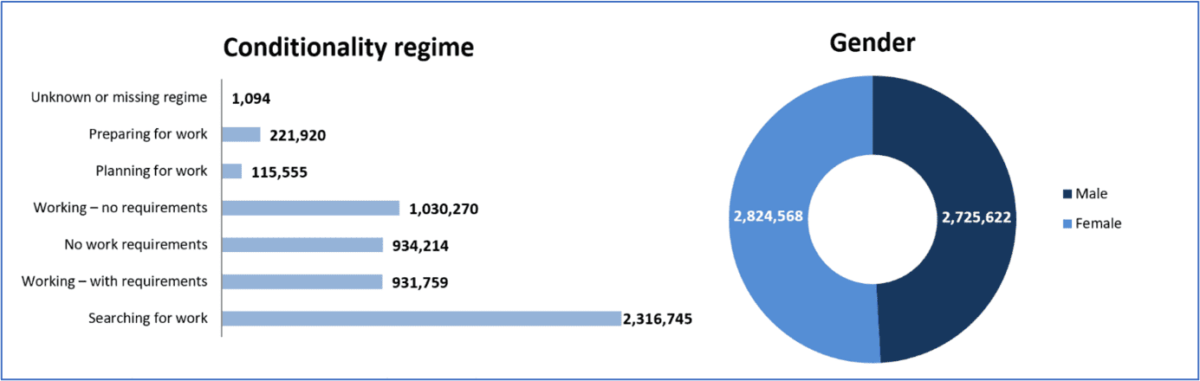
Source: DWP
The welfare benefits that are enabling employment for millions of people are as diverse as people’s life situations.
The system is designed – in principle – to be accessible for all, geared to fulfilling people’s potential employability on an individual level, rather than stifling it.
Universal Credit, for example, is a means-tested benefit which is geared to supporting low income families, whether they are in work or not. The childcare element of Universal Credit can pay up to 85% of childcare costs if household income is below a minimum threshold, making a huge difference to working families, and ensuring that they are not disincentivised to work through the cost of childcare provision. It would be helpful if families that are concerned about losing childcare benefits by progressing into employment were aware that this help is available, because it’s highly likely that their starting assumption is that it isn’t. The Carers element of Universal Credit makes work accessible for those who are undertaking caring responsibilities for 35 or more hours a week; this can support someone to continue to work at least part-time, supplementing their wage to make room to look after a disabled family member, for example, and can remove barriers for many working and single parent families. Helping families to recognise that moving into a caring role does not preclude them from working, and that working part-time can make them better off than leaving employment altogether, is key to avoiding working adults leaving their job altogether when they’re facing these challenges. There’s no doubt that welfare benefits can enable employment for people in this position.
Benefits for working adults also include non means-tested benefits such as Personal Independence Payment (PIP) and government schemes that include Access to Work, both geared to removing personal barriers which can affect employability. At a practical level, this can include anything from access to aids such as a disabled person’s railcard, bus pass, the Motability car scheme, or a blue badge – all significant in improving people’s ability to travel to work. Access to Work enables employers to access special equipment, adaptations or support worker services to help them in the workplace as well as with getting to and from work.
Like Universal Credit and PIP, key to the success of these welfare benefits in enabling employability is the knowledge and support of the wider system – including employers and health professionals. If people become aware that these benefits are available to them as early as possible, and they can be supported to access them, as easily as possible, jobs can be saved through benefits. With the right benefits in place unemployed people will more readily access and retain jobs, avoiding them being unfairly disadvantaged by their need to tackle life challenges while they are working.
The benefits system and the push for employment
It is difficult to imagine how anyone living in crisis, not even sure whether they will soon have a roof over their head, unable to feed their family and coping with domestic chaos, could possibly be motivated and sufficiently confident to look for employment. Yes, a job would lead to a better income that in turn can help to turn around a challenging family situation, but that journey can be long and complex. Welfare benefits, if accessed effectively, can provide for basic needs during these times of crisis, and keep families together and safe.
Our primary challenge, then, is to ensure that once a foundation of security is established, this is quickly converted into a platform for progression, avoiding it transforming into a barrier to employment or a crutch.
Like it or loath it in practice, but the principles of Universal Credit when it was announced by the Conservative party 10 years ago were hard to argue with, cast as fairer for claimants and taxpayers, and designed to avoid the ‘cliff edge’ that was said to ‘trap’ people in unemployment when benefits ended as work started. Although the UC system has been criticised in practice (much of this criticism, in my view, being fair), many have gained employment as a result of the ‘extra push’ it has given. For people who have been assessed as needing to search for employment, Universal Credit payments are made in return for evidence of active job search activities. This can be anything from training, volunteering, or submitting job applications. Evidence of this activity being absent results in sanctions – reduced benefits payments – which have been proven, for some, to focus the mind on looking for work.
The welfare benefits system – including the broader employability support system – has the capability of giving people the ‘third party’ push they need to spur their confidence and help them to actively seek employment. This can be in the form of people pressure, or through the nature of the systems and processes in place, but to be effective it also needs to be person-centred. The support system surrounding welfare benefits that has been set up by DWP included the introduction of Job Centre work coaches. These coaches are intended to build relationships with benefits claimants, and to provide them tangible support to become more active in the job market.
On the ground, the level of service offered is inconsistent, and not everyone is able to recognise the benefit of this support or understand how take best advantage of it. It is therefore important that other players in the support system take an active role in brokering these relationships, ensuring that the claimant recognises the purpose of the work coach’s role in helping them to move forward but also, pragmatically, ensuring that the benefit claimant is clear about what they should expect, so they get all of the support that’s available to them; people need to be educated to expect regular access to relevant training and development, support with CVs and applications, and also to receive practical help with access to grants for travel to interviews and clothing to improve the likelihood of a successful outcome on the day (this can relate to increased confidence as much as making a good first impression to a prospective employer). This is a two-way street.
This role is being played by employability professionals and independent agencies such as Citizens Advice, however this interaction often comes at the point of crisis. More can be done at the outset to avert crisis, and perhaps in some cases it’s not ideal for the paymaster to own this responsibility.
So can welfare benefits actually hinder employability?
We can’t pretend that welfare benefits is the silver bullet that will fix unemployment, but there’s no question that attitudes to benefits need to change. The lazy stereotype image isn’t owned exclusively by the media. People who are claiming benefits feel the stigma. Some worry about whether they should make a claim and decide not to although they will suffer a detriment as a result, ‘just in case’. When applying for jobs, concerns about recruiters discriminating against them because they claim benefits is a real barrier to making the effort to apply in the first place.
People who have been in the position of claiming welfare benefits for long periods can be prone to believing they have become unemployable.
The bias of employers – unconscious or otherwise – can serve to further entrench these barriers – employing someone who is already in employment feels a lot easier and lower risk than employing someone who is long-term unemployed, does it not.
Helping employers to engage unemployed applicants in volunteer programmes to provide work experience, or work trials before a full commitment to a job is made, would make a huge difference, supporting people who feel ‘trapped’ in the benefits system to break down these barriers, and better equipping the employer and the prospective employee to remove prejudices associated with welfare benefits as a hinderance to employability.
If you would like to talk about how you could start breaking down these barriers in your organisation please get in touch; if we can’t help ourselves we’re pretty sure we’ll know someone who can.
A call to action – let’s change attitudes
So, do welfare benefits propel or prevent employment? I usually resist the temptation to talk about culture as it’s a pretty intangible concept in real terms and we can almost exonerate ourselves of responsibility for pretty much anything by blaming culture. But in real terms our attitudes shape the culture that exists around welfare benefits and unemployment, so our call to action today is for us to work together to help those who have found themselves claiming benefits for whatever reason to know that this offers a safe platform for progression back into employment, that the stigma that may have been attached to welfare benefits in the past no longer exists, and that benefits actually enable millions of people to work.
Jayne Graham MBE (Director) and Adam Matthews (Social Welfare Instructor)
